
Client-ready

Write your deck in minutes instead of painting it for hours.

Decklay sets every slide to the standard your sponsor expects, so your time goes into the message, not the layout.
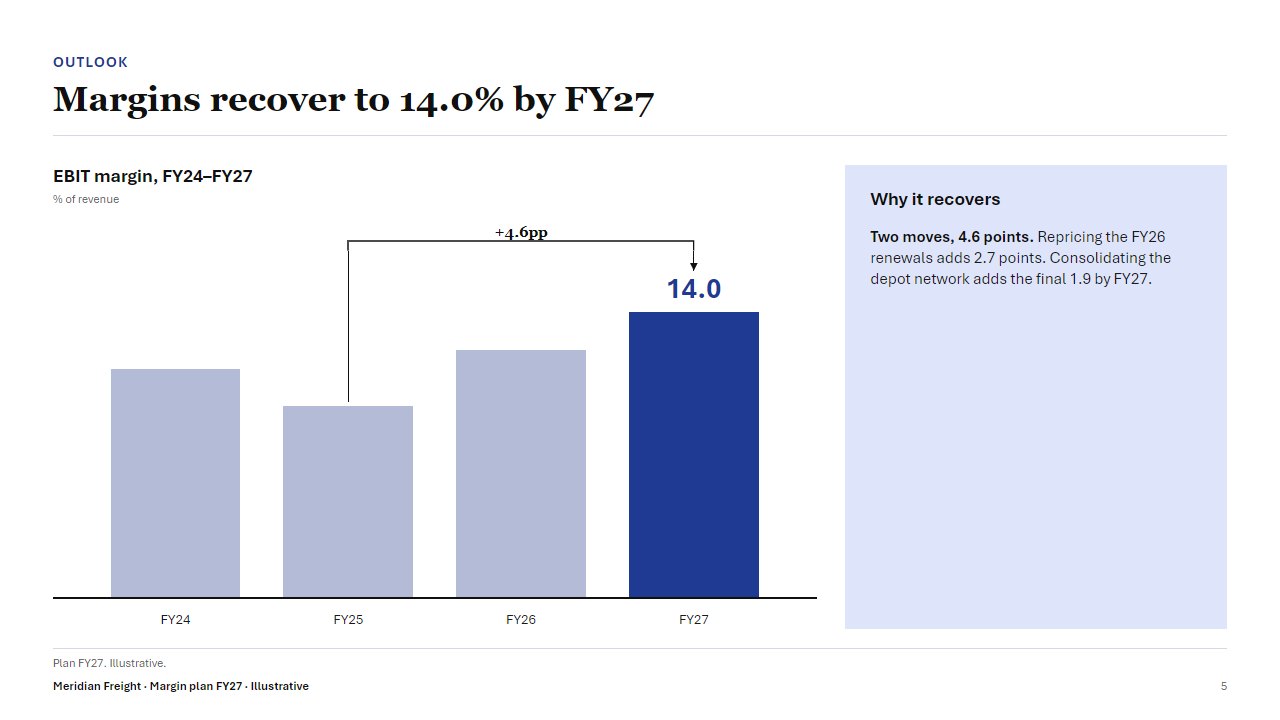
The compiled slide, as the app exports it: kicker Outlook, action title Margins recover to 14.0% by FY27, a column chart of EBIT margin FY24 to FY27 with FY27 highlighted and a +4.6pp arrow from FY25, a tinted textbox Why it recovers on the right, source line and page number 5.
Show the Markdown
# Margins recover to 14.0% by FY27
layout: 67/33
kicker: Outlook

## left
::: column-chart
head: EBIT margin, FY24–FY27
unit: % of revenue
scale: 15
diff: FY25..FY27
- FY24 :: 11.2
- FY25 :: 9.4
- FY26 :: 12.1
- FY27 :: 14.0 :: hi :: display=14.0
:::

## right
valign: center
::: textbox
head: Why it recovers
lead: Two moves, 4.6 points.
Repricing the FY26 renewals adds 2.7 points.
Consolidating the depot network adds the final 1.9 by FY27.
:::
source: Plan FY27. Illustrative.

Compiled from 25 lines of Markdown. Nothing was drawn.
Named values

Define a key figure once as a named value, and never do consistency checks again.
Change it in one place and every slide follows. The figures ledger checks that it did.
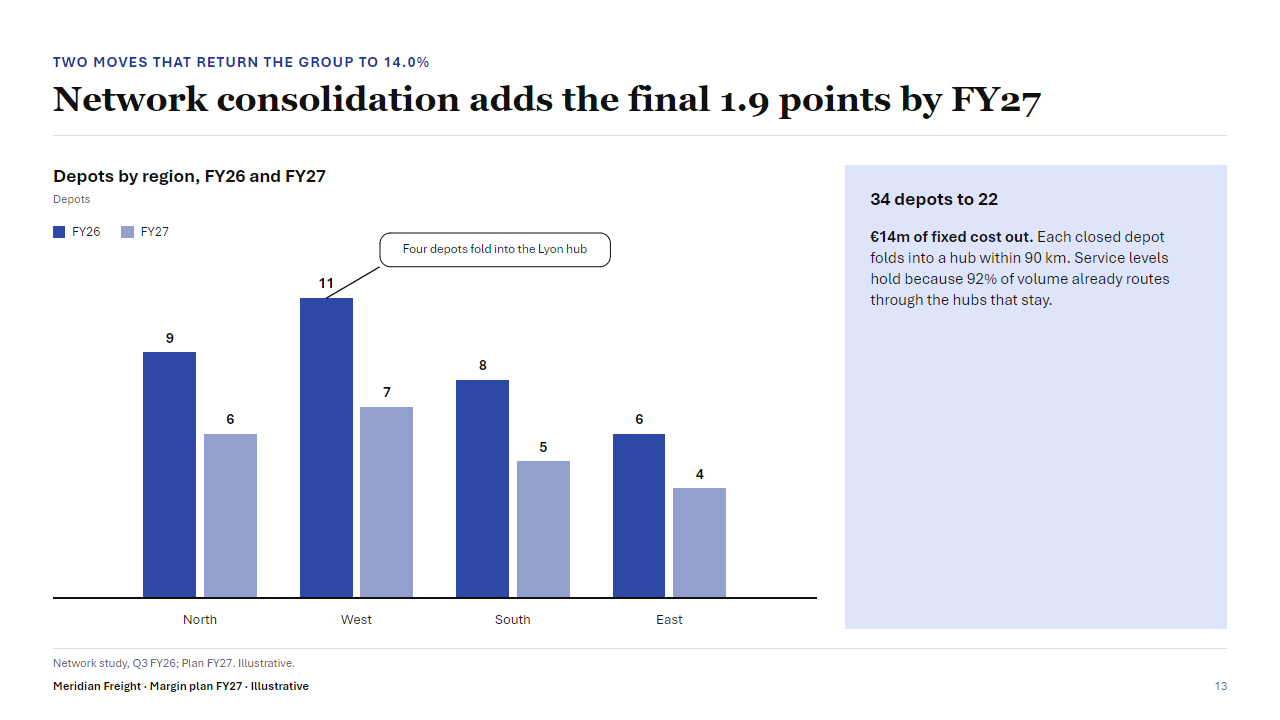
Slide: Network consolidation adds the final 1.9 points by FY27. Grouped columns of depots by region, FY26 against FY27, with a callout on the West FY26 bar, Four depots fold into the Lyon hub, beside a textbox 34 depots to 22.
Show the Markdown
---
numbers:
  m_fy27: 14.0
  pts_reprice: 2.7
  pts_network: 1.9
  depots_now: 34
  depots_fy27: 22
  …
---

# Network consolidation adds the final {{pts_network}} points by FY27
layout: 67/33

## left
::: column-chart
head: Depots by region, FY26 and FY27
unit: Depots
series: FY26 | FY27
values: all
- North :: 9 | 6
- West :: 11 | 7
- South :: 8 | 5
- East :: 6 | 4
:::

::: note
on: column-chart
points: West
series: FY26
Four depots fold into the Lyon hub
:::

## right
valign: center
::: textbox
head: {{depots_now}} depots to {{depots_fy27}}
lead: €14m of fixed cost out.
Each closed depot folds into a hub within 90 km. Service levels hold because 92% of volume already routes through the hubs that stay.
:::

source: Network study, Q3 FY26; Plan FY27. Illustrative.

Three named values on one slide, set once in the numbers block. The figures ledger checks every slide that prints one against it.

Four house styles

One standard, whichever room has to be convinced.

Define the style by a single line: Consulting for executives deciding, Banking for pitch books and M&A, Learning for teaching new concepts and Keynote for a room listening.

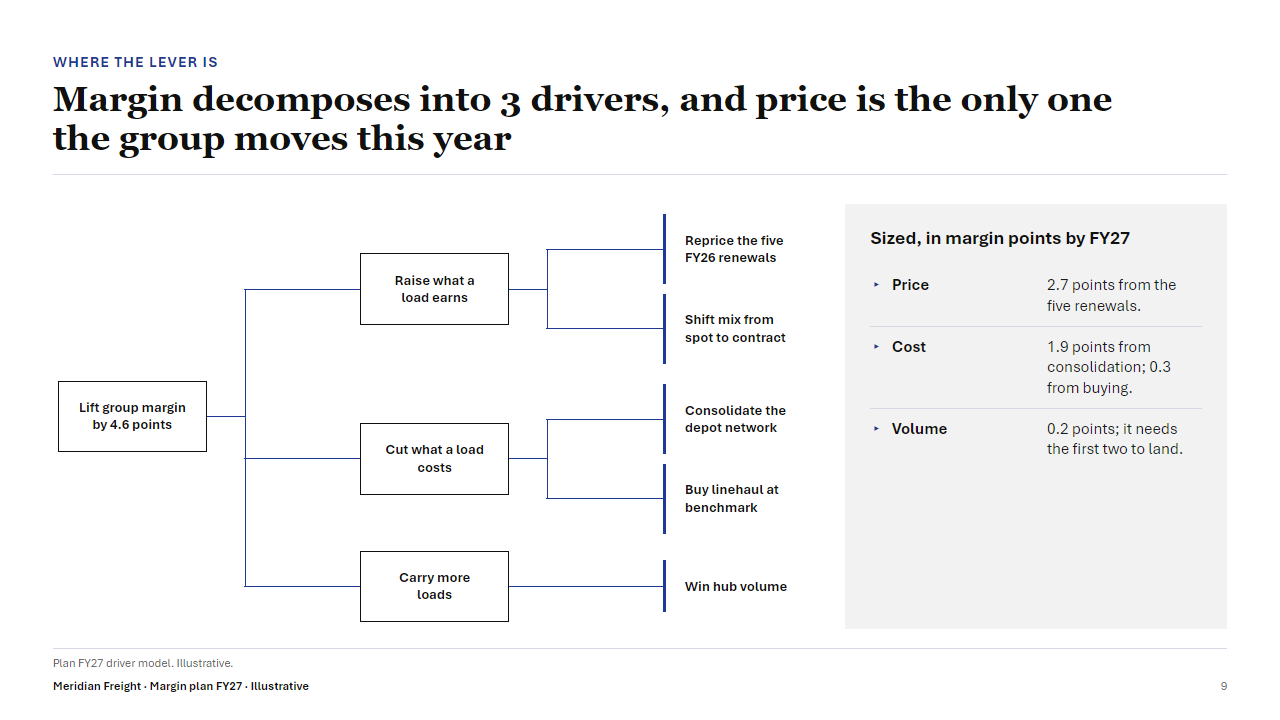
Slide in the Consulting style: Margin decomposes into 3 drivers, and price is the only one the group moves this year. An issue tree from Lift group margin by 4.6 points into price, cost and volume branches, beside a list sizing each in margin points.
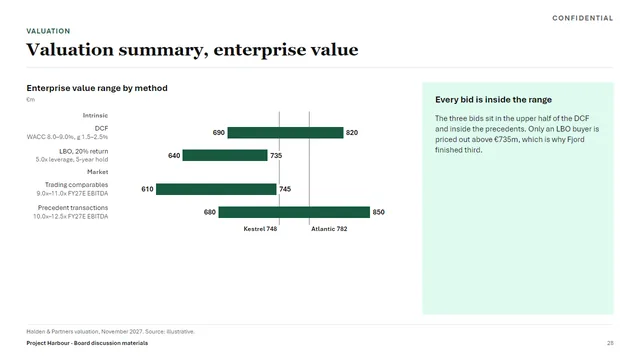
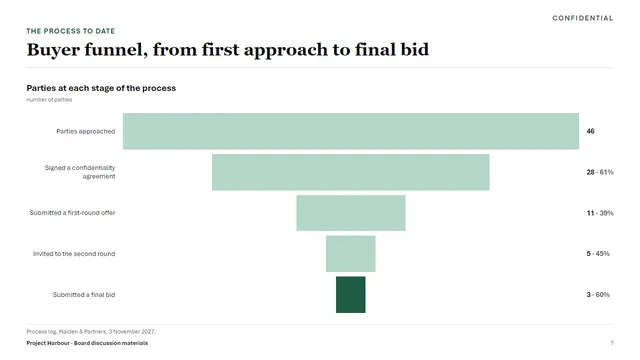
Slide in the Banking style: Valuation summary, enterprise value. A football field of four valuation methods in euro millions, DCF, LBO, trading comparables and precedent transactions, with the Kestrel and Atlantic bids drawn as lines across them, beside a textbox Every bid is inside the range.
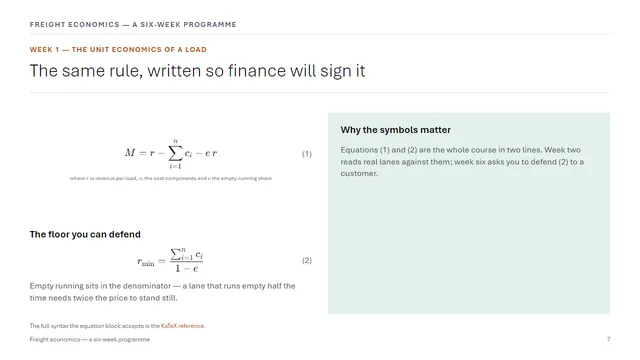
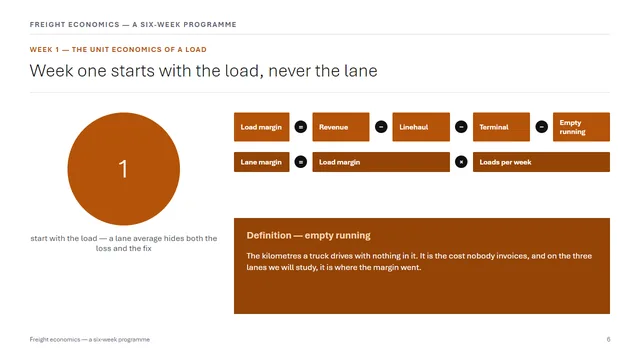
Slide in the Learning style: The same rule, written so finance will sign it. Two numbered equations for load margin and the break-even price, typeset from LaTeX, beside a textbox Why the symbols matter that cites equations 1 and 2.
Show the Markdown
---
style: consulting
…
---

# Margin decomposes into 3 drivers, and price is the only one the group moves this year
layout: 67/33

## left
::: decisions
mode: issue
- Lift group margin by 4.6 points
  - Raise what a load earns
    - Reprice the five FY26 renewals
    - Shift mix from spot to contract
  - Cut what a load costs
    - Consolidate the depot network
    - Buy linehaul at benchmark
  - Carry more loads
    - Win hub volume
:::

## right
valign: center
::: triangle-list
head: Sized, in margin points by FY27
- Price :: {{pts_reprice}} points from the five renewals.
- Cost :: {{pts_network}} points from consolidation; 0.3 from buying.
- Volume :: 0.2 points; it needs the first two to land.
:::

source: Plan FY27 driver model. Illustrative.
Show the Markdown
---
style: banking
…
---

# Valuation summary, enterprise value
layout: 67/33

## left
::: football-field
head: Enterprise value range by method
unit: €m
axis: none
ref: Kestrel 748 | Atlantic 782
- group: Intrinsic
- DCF :: 690 | 820 :: WACC 8.0–9.0%, g 1.5–2.5%
- LBO, 20% return :: 640 | 735 :: 5.0x leverage, 5-year hold
- group: Market
- Trading comparables :: 610 | 745 :: 9.0x–11.0x FY27E EBITDA
- Precedent transactions :: 680 | 850 :: 10.0x–12.5x FY27E EBITDA
:::

## right
::: textbox
head: Every bid is inside the range
The three bids sit in the upper half of the DCF and inside the precedents. Only an LBO buyer is priced out above €735m, which is why Fjord finished third.
:::

source: Halden & Partners valuation, November 2027. Source: illustrative.
Show the Markdown
---
style: learning
…
---

# The same rule, written so finance will sign it
layout: 50/50
kicker: Week 1 — the unit economics of a load

## left
::: equation
label: loadmargin
note: where $r$ is revenue per load, $c_i$ the cost components and $e$ the empty-running share
M = r - \sum_{i=1}^{n} c_i - e\,r
:::

::: equation
head: The floor you can defend
label: breakeven
below: Empty running sits in the denominator — a lane that runs empty half the time needs twice the price to stand still.
r_{\min} = \frac{\sum_{i=1}^{n} c_i}{1 - e}
:::

## right
::: textbox
head: Why the symbols matter
Equations @eq:loadmargin and @eq:breakeven are the whole course in two lines. Week two reads real lanes against them; week six asks you to defend @eq:breakeven to a customer.
:::

source: The full syntax the equation block accepts is the [KaTeX reference](https://katex.org/docs/supported).

Consulting, for executives deciding: an issue tree beside the list that sizes each branch.

Banking, for books read line by line: a football field with the two final bids ruled across every method.

Learning, for teaching: two numbered LaTeX equations, cited by label from the prose beside them.

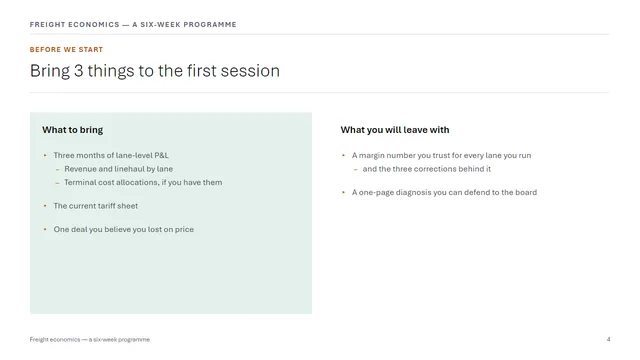
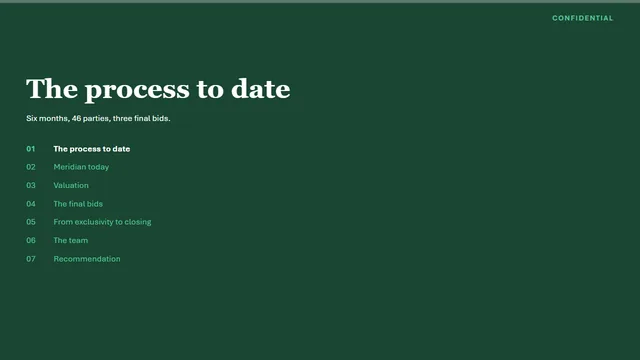
Sample slides from three house styles.Each deck is one Markdown file. Every figure recurs from a named value, every exhibit carries its source line.
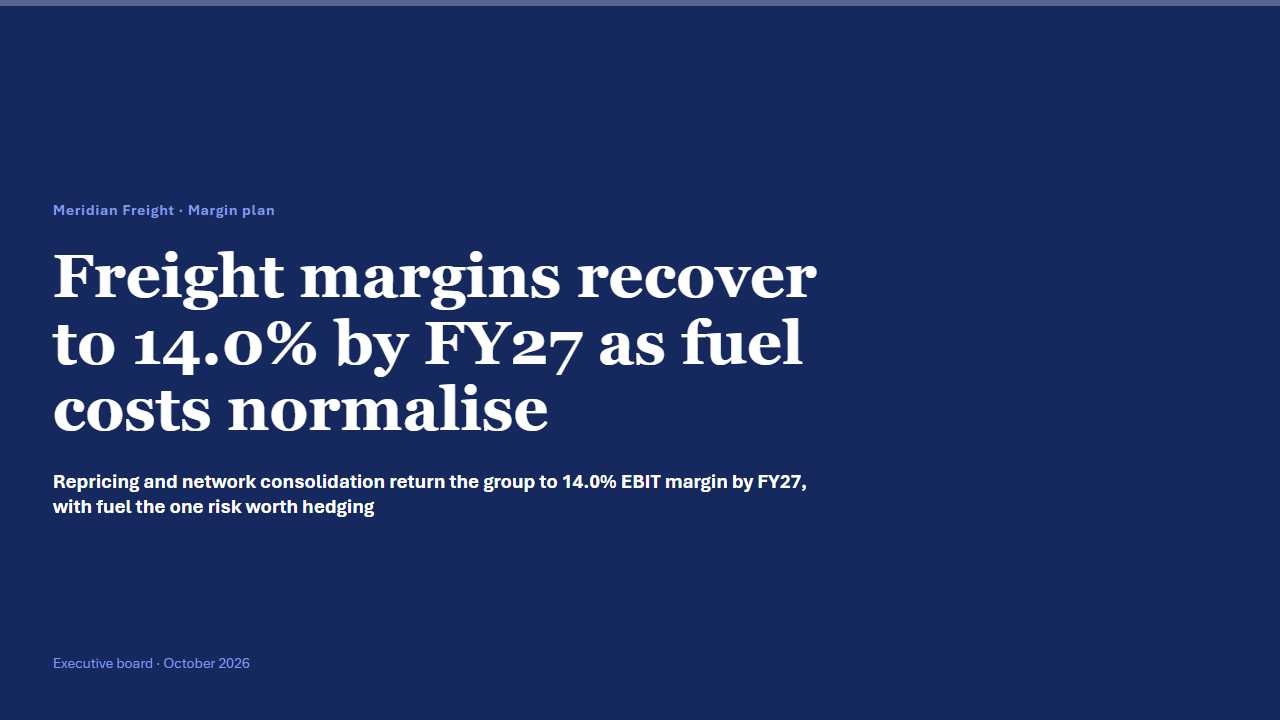
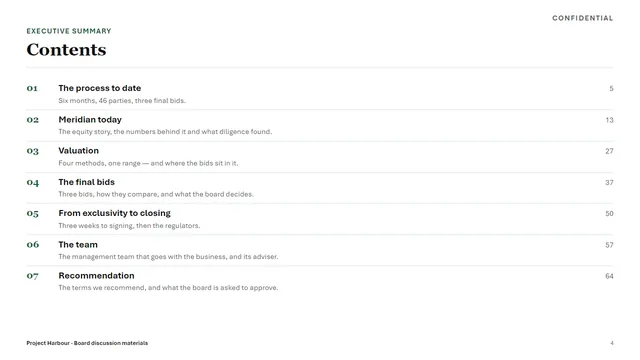
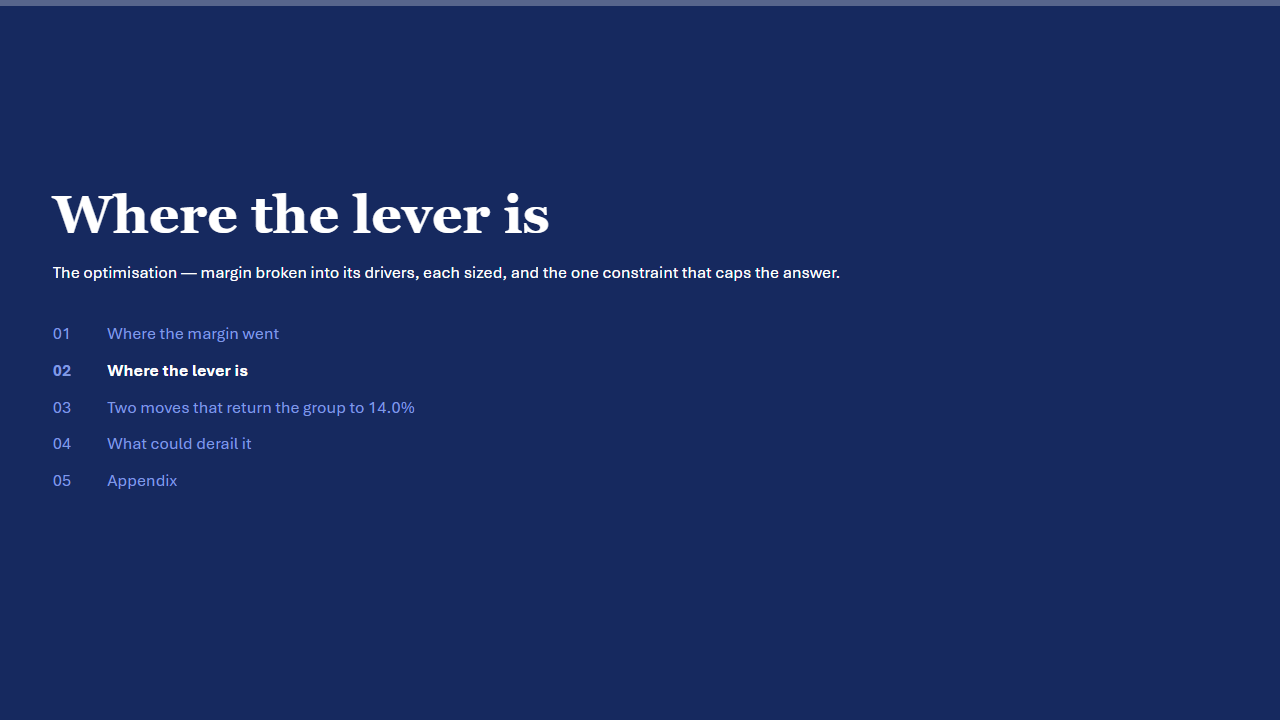
Cover slideLearning sample deck slideBanking sample deck slideDivider: Where the margin went slideLearning sample deck slideBanking sample deck slideDivider: Two moves slideLearning sample deck slideBanking sample deck slideDivider: What could derail it slideLearning sample deck slideBanking sample deck slideBanking sample deck slideBanking sample deck slideBanking sample deck slideBanking sample deck slideBanking sample deck slideBanking sample deck slideBanking sample deck slideBanking sample deck slideBanking sample deck slideBanking sample deck slideBanking sample deck slideBanking sample deck slideBanking sample deck slideBanking sample deck slideBanking sample deck slideBanking sample deck slideBanking sample deck slideBanking sample deck slideBanking sample deck slideBanking sample deck slideBanking sample deck slideBanking sample deck slideBanking sample deck slideBanking sample deck slideBanking sample deck slideBanking sample deck slideBanking sample deck slideBanking sample deck slideBanking sample deck slideBanking sample deck slideBanking sample deck slideBanking sample deck slideBanking sample deck slideBanking sample deck slideBanking sample deck slideBanking sample deck slideBanking sample deck slideBanking sample deck slideBanking sample deck slideBanking sample deck slideBanking sample deck slideBanking sample deck slideBanking sample deck slideBanking sample deck slideBanking sample deck slideBanking sample deck slideBanking sample deck slideBanking sample deck slideBanking sample deck slideBanking sample deck slideBanking sample deck slideBanking sample deck slideBanking sample deck slide
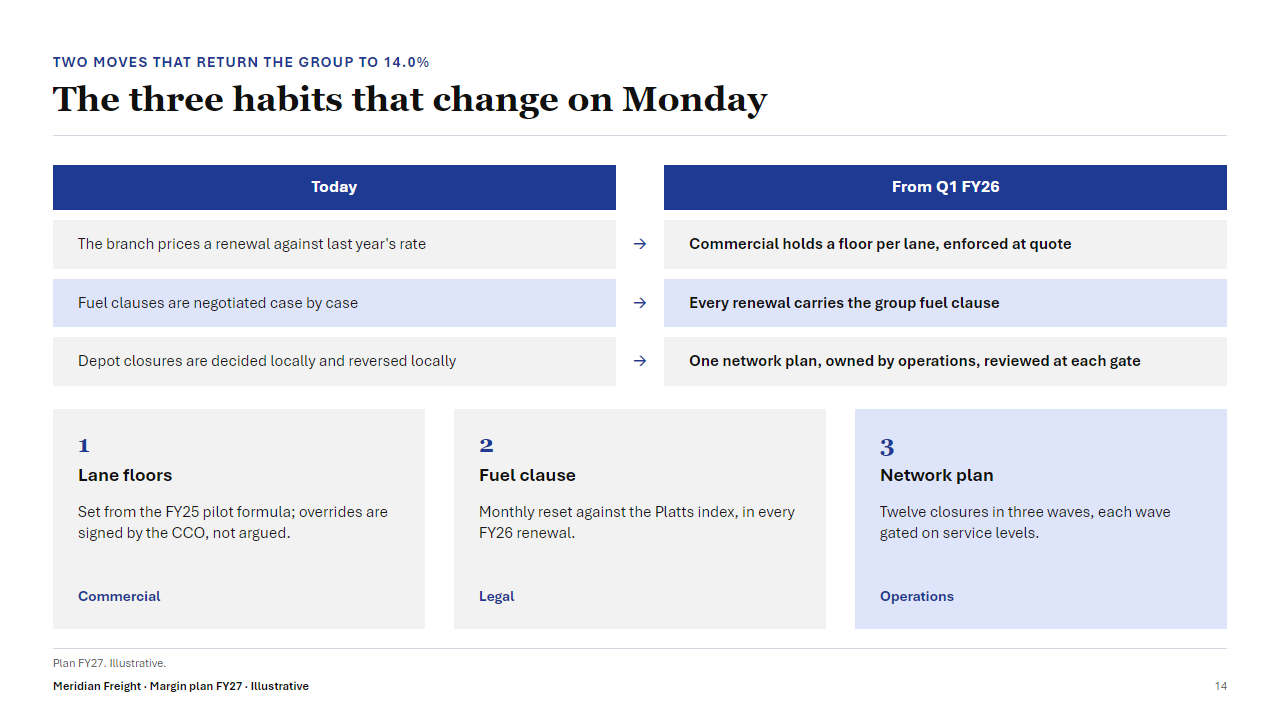
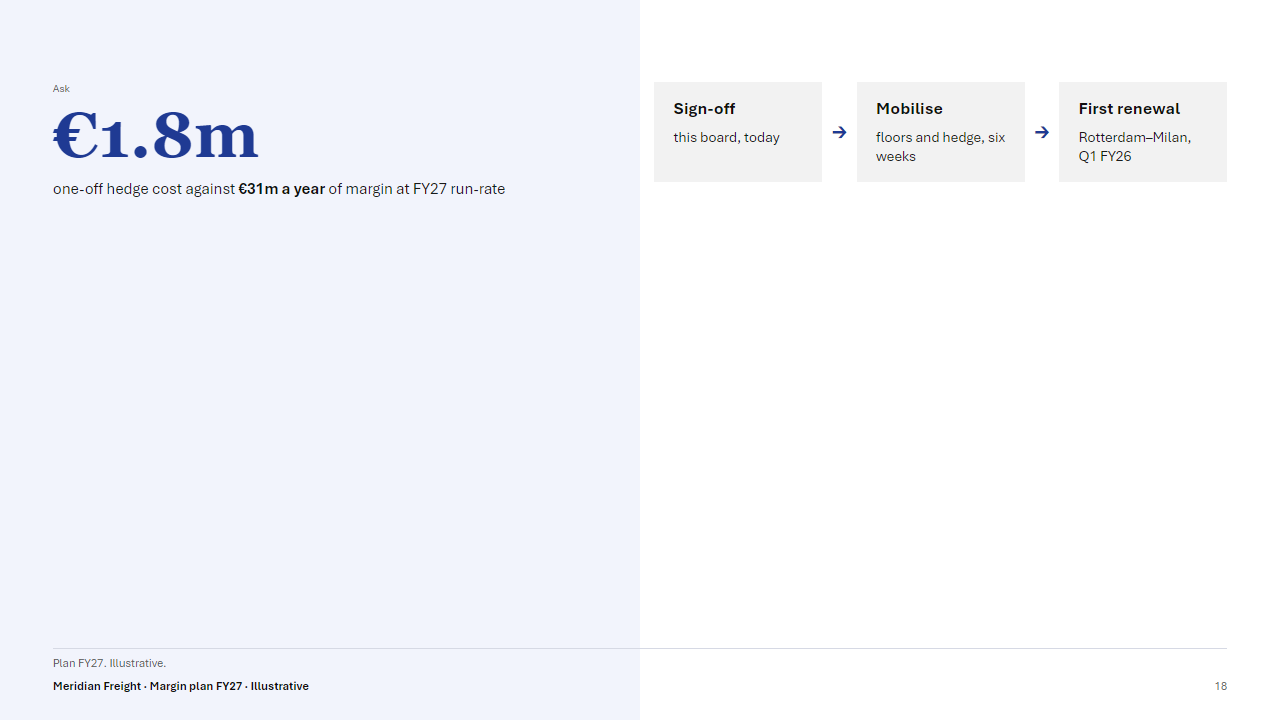
Banking sample deck slideAgenda slideLearning sample deck slideBanking sample deck slideDivider: Where the lever is slideLearning sample deck slideBanking sample deck slideFrom-to and cards slideLearning sample deck slideBanking sample deck slideThe ask slideLearning sample deck slideLearning sample deck slideLearning sample deck slideLearning sample deck slideLearning sample deck slideLearning sample deck slideLearning sample deck slideLearning sample deck slideLearning sample deck slideLearning sample deck slideLearning sample deck slideLearning sample deck slideLearning sample deck slideLearning sample deck slideLearning sample deck slideLearning sample deck slideLearning sample deck slideLearning sample deck slideLearning sample deck slideLearning sample deck slideLearning sample deck slideLearning sample deck slideLearning sample deck slideLearning sample deck slideLearning sample deck slideLearning sample deck slideLearning sample deck slideLearning sample deck slideLearning sample deck slideLearning sample deck slideLearning sample deck slideLearning sample deck slideLearning sample deck slideLearning sample deck slideLearning sample deck slideLearning sample deck slideLearning sample deck slideLearning sample deck slideLearning sample deck slideLearning sample deck slideLearning sample deck slideLearning sample deck slideLearning sample deck slideLearning sample deck slideLearning sample deck slideLearning sample deck slideLearning sample deck slideLearning sample deck slideLearning sample deck slideBanking sample deck slideBanking sample deck slideBanking sample deck slideBanking sample deck slideBanking sample deck slide

Focus on what's important

At 11pm, work on the message, not on the layout

Slide software makes you paint every slide with a mouse, then repaint it after every edit. In Decklay you type the argument, and the design system sets the slide.

Painting with a mouseWriting in Decklay
Draw, drag, align and resize every boxType one line per idea; the slide is laid out for you
Rebuild a slide to change its layoutChange the layout line; the slide re-fits
Fix fonts and spacing slide by slideOne locked design system for the whole deck
Hunt for the figure on slide 19Define it once; every slide agrees
Reach for the mouseKeyboard-first: Ctrl+K reaches every control

Total control

From full page to 50/50 in a three-line edit

Every slide is text you control: its structure, its words, its numbers. Change the layout line, mark the two columns, and the compiler re-fits the slide. Nothing to drag.

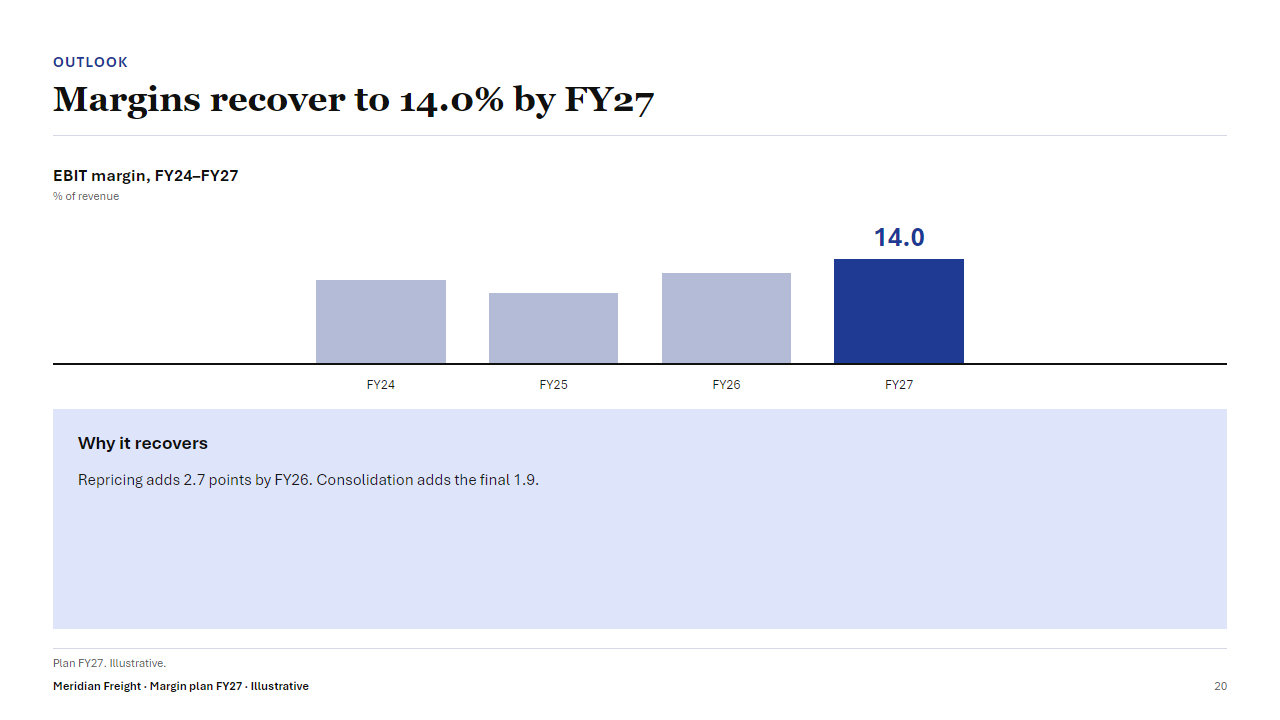
# Margins recover to 14.0% by FY27
layout: 100
kicker: Outlook

::: column-chart
head: EBIT margin, FY24–FY27
unit: % of revenue
scale: 15
- FY24 :: 11.2
- FY25 :: 9.4
- FY26 :: 12.1
- FY27 :: 14.0 :: hi :: display=14.0
:::

::: textbox
head: Why it recovers
Repricing adds 2.7 points by FY26.
Consolidation adds the final 1.9.
:::
The exported slide in full-page layout: the column chart across the top, the Why it recovers textbox below it.
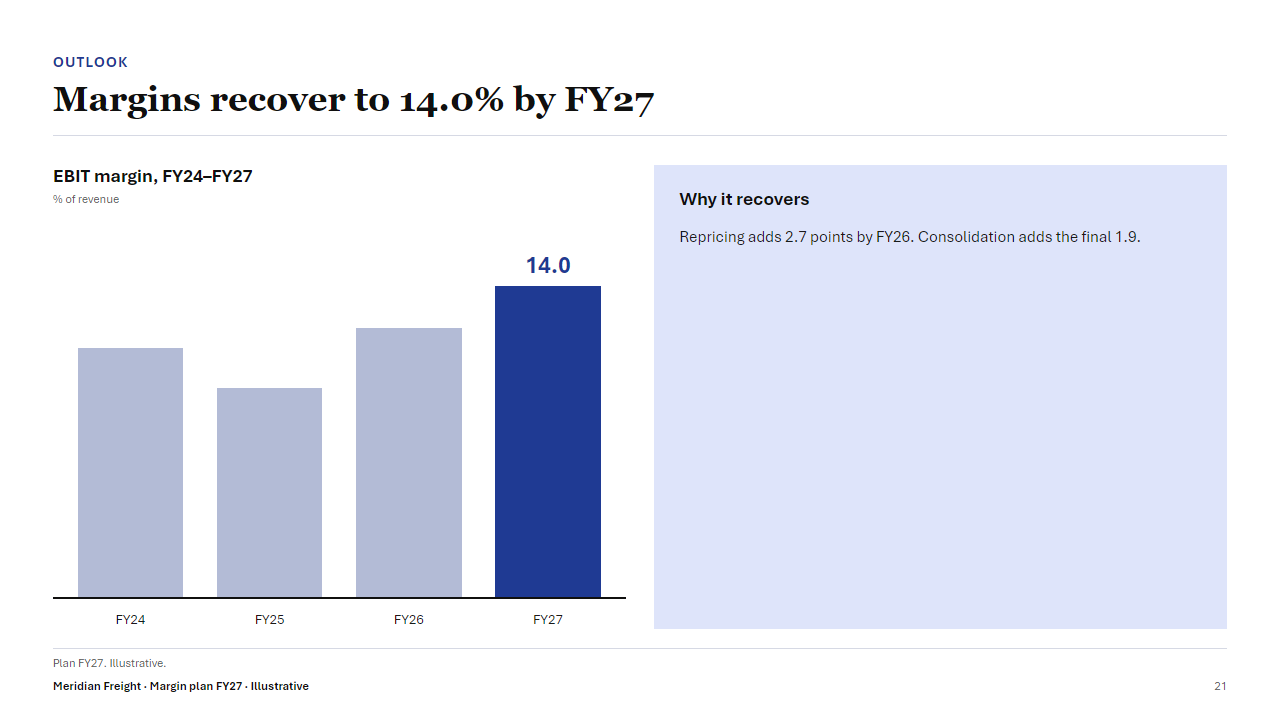
# Margins recover to 14.0% by FY27
layout: 50/50
kicker: Outlook

## left
::: column-chart
head: EBIT margin, FY24–FY27
unit: % of revenue
scale: 15
- FY24 :: 11.2
- FY25 :: 9.4
- FY26 :: 12.1
- FY27 :: 14.0 :: hi :: display=14.0
:::

## right
::: textbox
head: Why it recovers
Repricing adds 2.7 points by FY26.
Consolidation adds the final 1.9.
:::
The same slide exported in 50/50 layout: the column chart on the left, the Why it recovers textbox on the right.

Highlighted lines are the whole change. Both slides are the app's own exports.

Built for decision decks

The craft of a well-made deck, enforced by the compiler

Keyboard-first, by design

Every control is reachable by typing, and the live preview redraws the slide you're editing as you type. Your hands stay on the argument.

Ctrl+K · ~24 ms per slide · 30 slides in under 150 ms

Nothing overflows

Each slide solves its own density and never uses more than two type sizes. When content still won't fit, it is cut cleanly and you are told where.

spacing → margin → type step → warning

Every number agrees

Define a figure once as a named value and print it anywhere. The figures ledger checks that one number says the same thing on every slide.

{{revenue_fy26}} · Deck → Figures…

More than 60 consulting exhibits

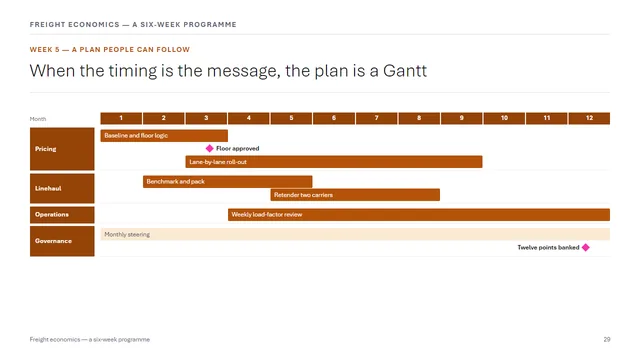
Waterfalls, Mekko, slopegraphs, matrices, issue trees, Gantt charts, org charts, plus banking and frameworks packs that arrive pre-filled.

waterfall · Mekko · football field · Gantt

Craft Check before the partner does

Machine-checkable craft rules, reported as advice: numerals in titles, units, sources, dates. Errors point to the line and name the nearest valid field.

Deck → Craft Check… · decklay craft

Every version, side by side

A deck is text, so milestones and snapshots are plain files. Compare two versions slide by slide, even after reordering.

milestones · snapshots · compare

Six of the exhibits, as the compiler set them

All from one sample deck in the Consulting style. Every figure recurs from a named value, every exhibit carries its source line.

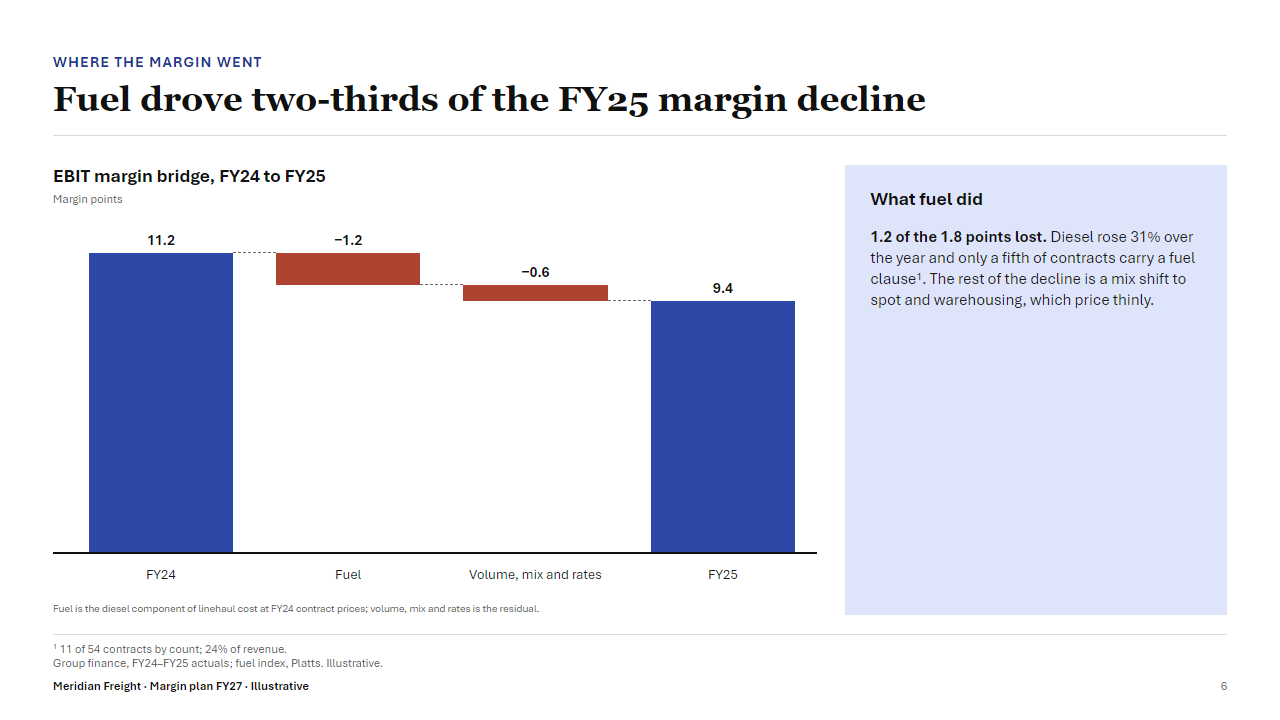
Slide: Fuel drove two-thirds of the FY25 margin decline. A waterfall from FY24 11.2 through fuel minus 1.2 and volume, mix and rates minus 0.6 to FY25 9.4, with a textbox What fuel did.
WaterfallThe bridge prints its own computed total; a footnote is numbered and placed above the source line.
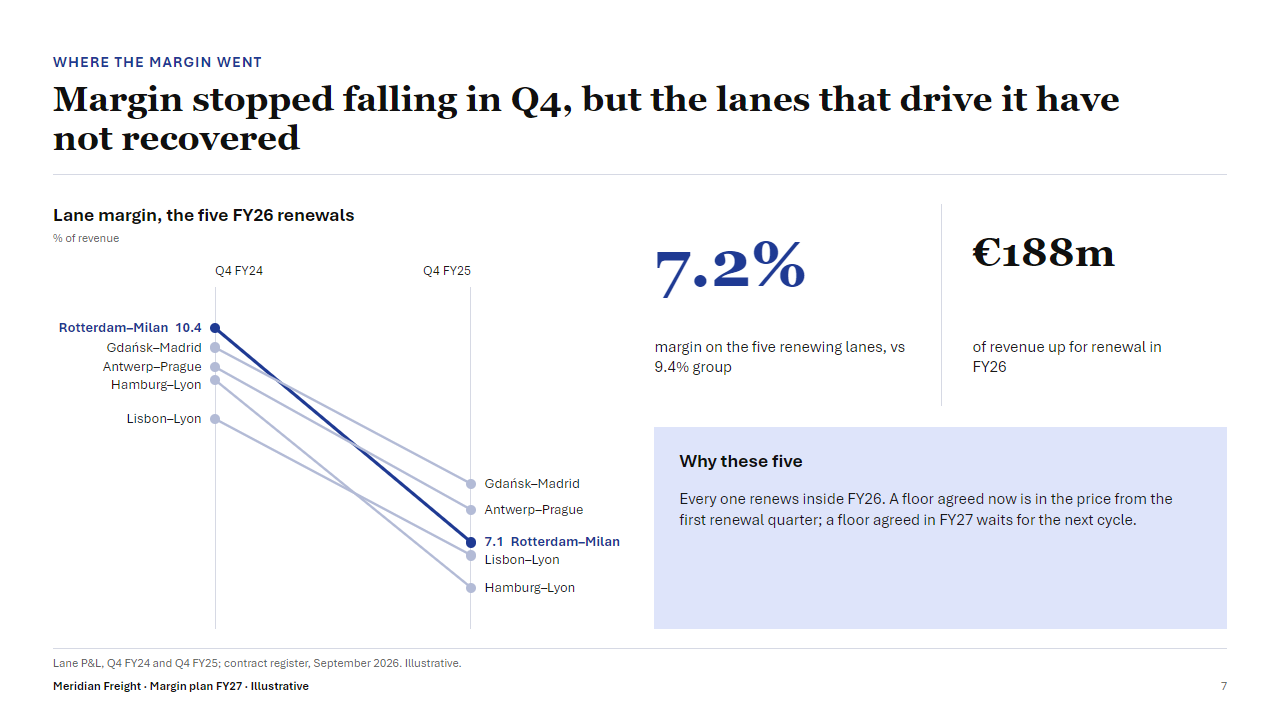
Slide: Margin stopped falling in Q4, but the lanes that drive it have not recovered. A slopegraph of five lanes between Q4 FY24 and Q4 FY25 with Rotterdam–Milan highlighted, beside the figures 7.2% and €188m.
Slopegraph and hero numbersOne highlighted lane, two big figures, one accent.
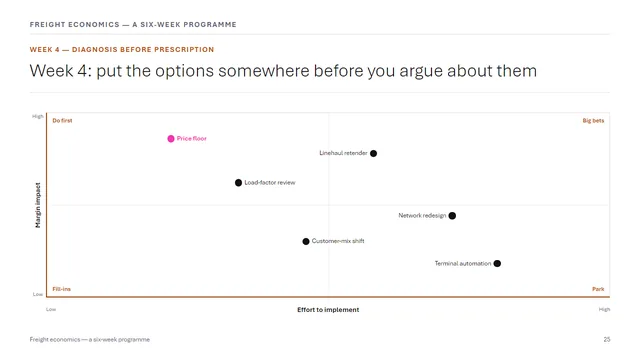
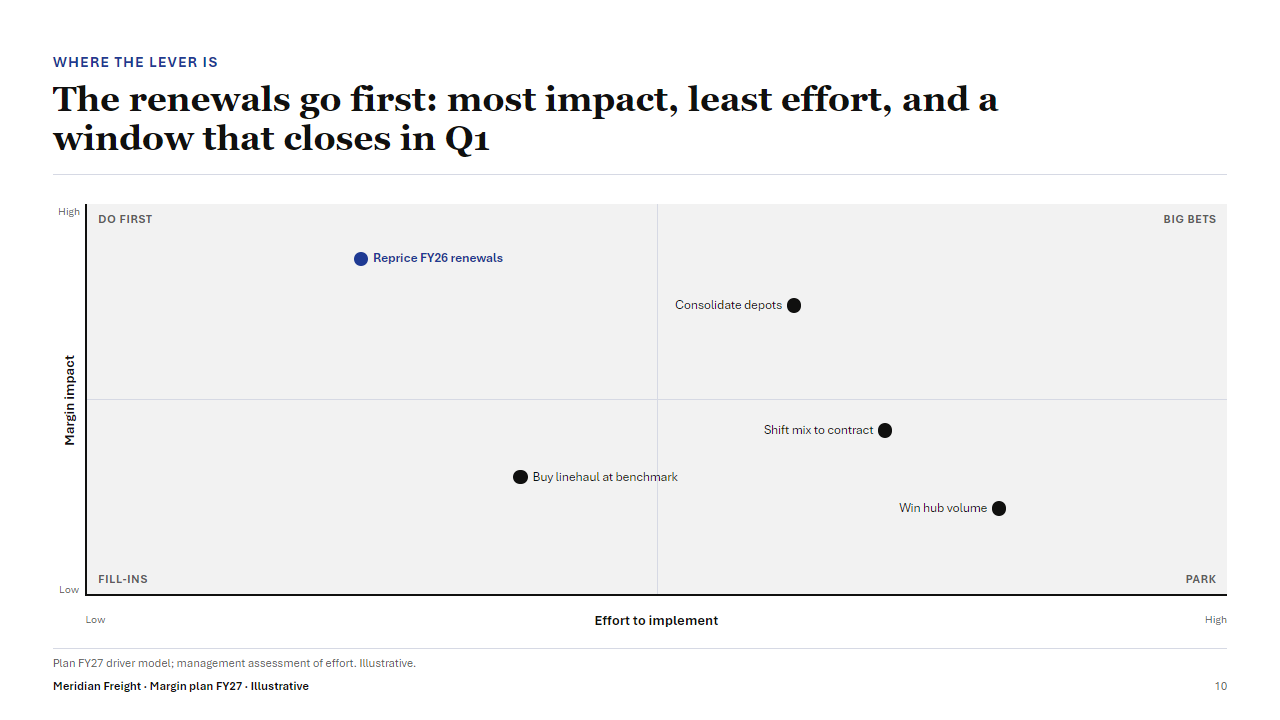
Slide: The renewals go first. A two-by-two map of effort against margin impact with five moves placed and Reprice FY26 renewals highlighted in Do first.
QuadrantNamed corners, one highlighted move.
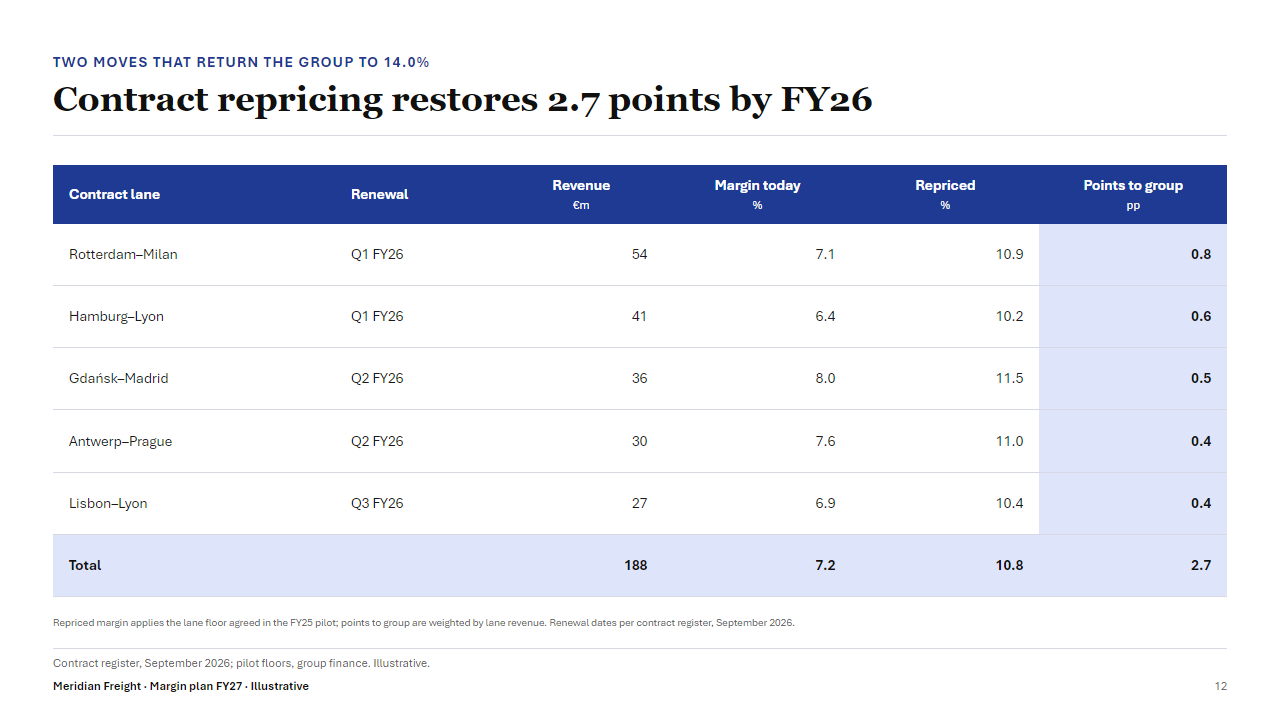
Slide: Contract repricing restores 2.7 points by FY26. A table of five contract lanes with renewal quarter, revenue, margin today, repriced margin and points to group, totalling 2.7.
TableUnits in the header, the message column tinted, the total ruled.
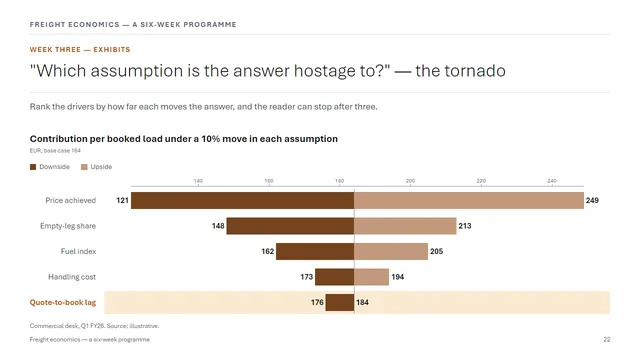
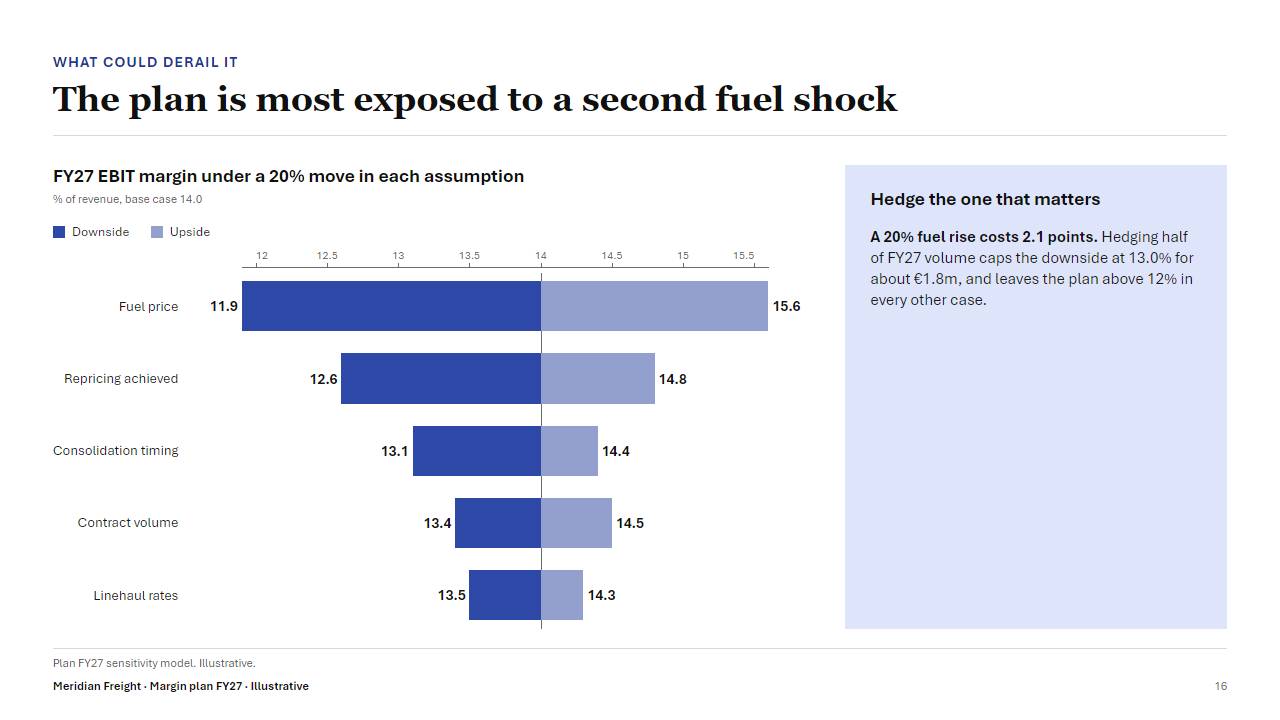
Slide: The plan is most exposed to a second fuel shock. A tornado chart of FY27 margin under five assumptions, fuel price widest from 11.9 to 15.6.
TornadoRanked widest-first by the compiler, every bar labelled.
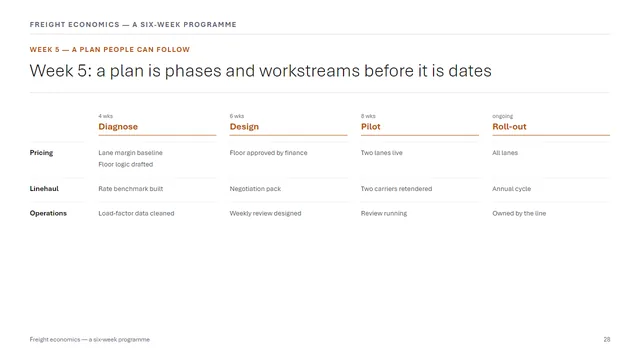
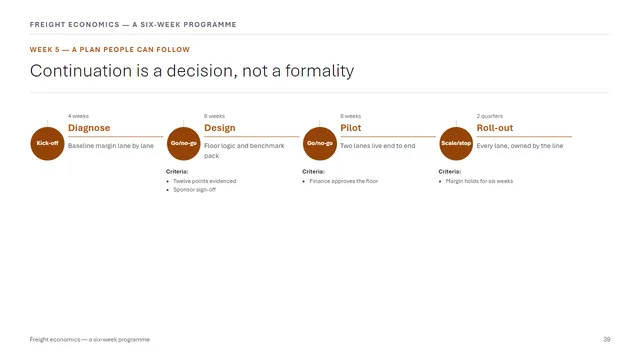
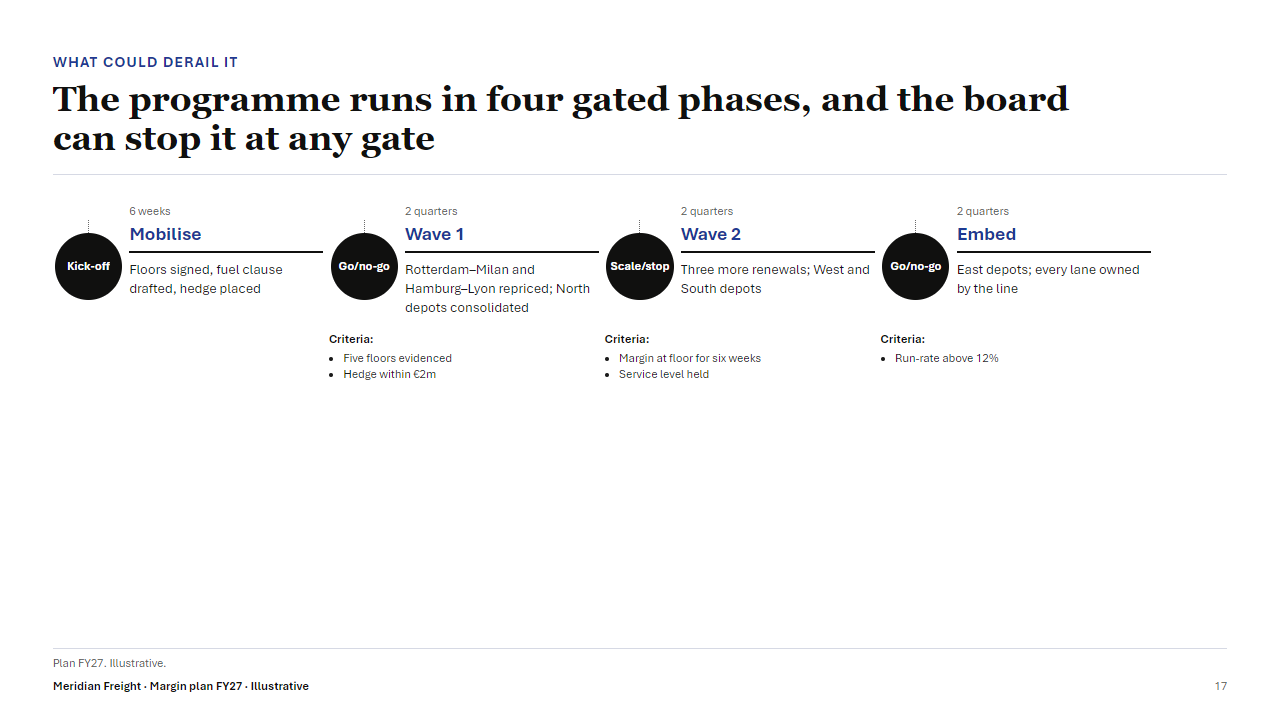
Slide: The programme runs in four gated phases. Four phases from Mobilise to Embed, each with a timeframe, a gate and its criteria.
Stage-gatePhases, gates and the criteria each gate tests.

AI-native, AI-optional

Markdown is the language of AI, so your deck already speaks it

You choose how much AI touches a deck. All three ways work on the same file, and none of them is required.

  1. 1 · Without AI

    Everything works offline

    Writing, compiling, presenting and every export need no account and no connection. When you want nothing to leave the machine, nothing does.
  2. 2 · With the built-in co-author

    Sandboxed, on your own account

    Research and draft from a topic or your own memo, Word file or PDF. Shape the outline before a slide exists. Guardrails on every call, switches for web search and for what deck text is sent, an opt-in log beside the deck. Runs on your Claude subscription or Anthropic API key.

  3. 3 · With any public model

    Any AI can write the file

    Ask any model to draft or rework the deck file, and Decklay picks up the change live. A Claude skill writes decks from any Claude session.

Shape the outline before a slide exists

Research & draft proposes every slide's title and its "so what" as one storyline. You edit the argument there, where a change costs a line, and approve it before any slide is drafted.

Your firm's way of writing

The co-author's instructions and storylines are plain-text files you can edit.

The Committee

Before the CFO reads your deck, let the CFO read your deck

Reviewers read the draft as the offices you choose. Their notes arrive as opinions, kept apart from the compiler's warnings, so you always know which is which. Like the rest of the co-author, it runs on your own Claude account.

CEOCFOCHROCOOCMOHead of strategy+ your own office

Each reviewer is a plain-text persona beside the co-author's instructions. Edit how the CFO reads, or add any office your firm has.

House styles

Four styles, each built for how its slides are read

Re-skin with your colours and fonts; the layout rules stay locked. Any colour you pick gets readable contrast automatically.

  • ConsultingFor executives deciding. Action titles, exhibits that fit, an executive summary that carries the whole arc.
  • BankingFor books read line by line. Trading comps, precedents, football fields, and the number conventions that go with them.
  • LearningFor teaching. Question titles, numbered equations, a running head.
  • KeynoteFor a room listening, dark or light. One number, one idea per slide.
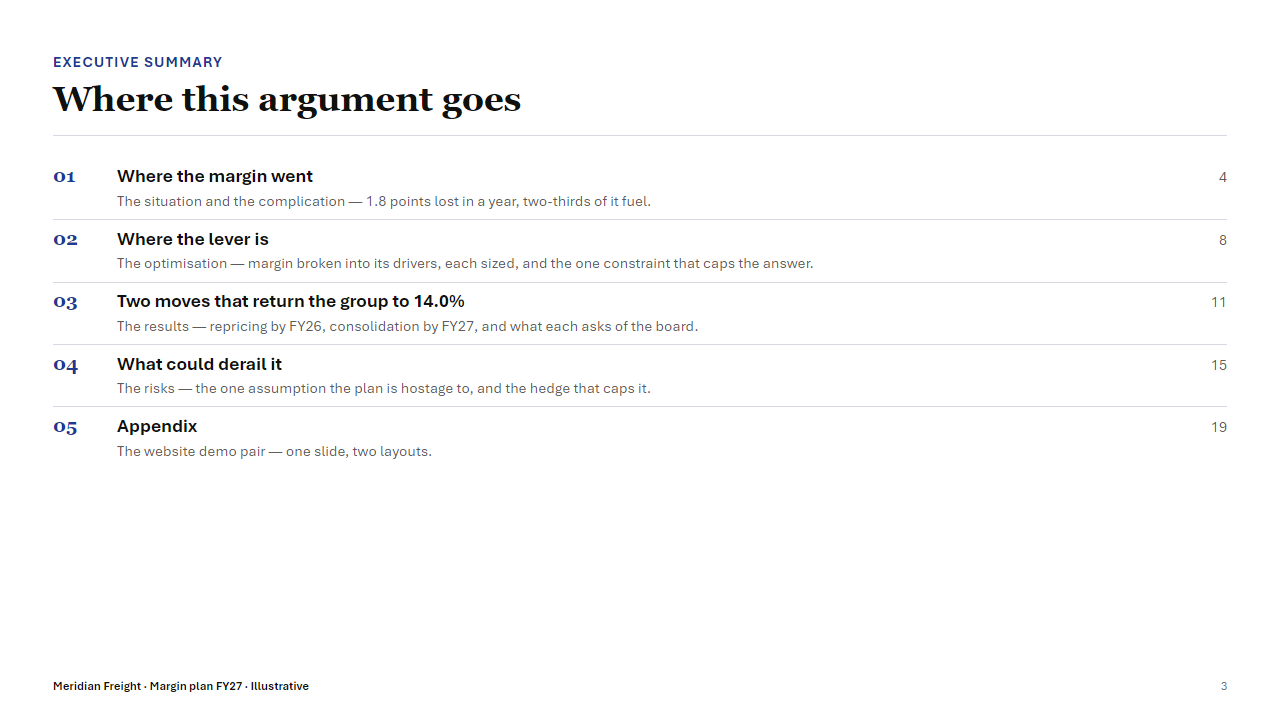
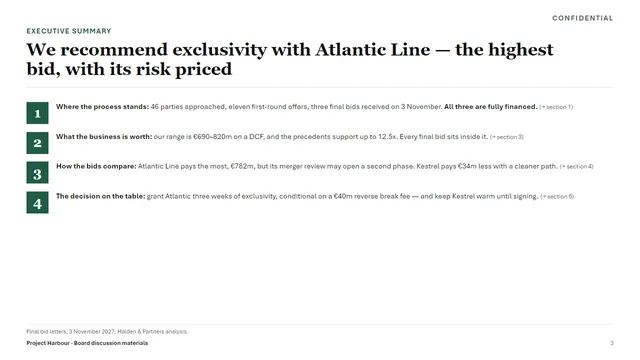
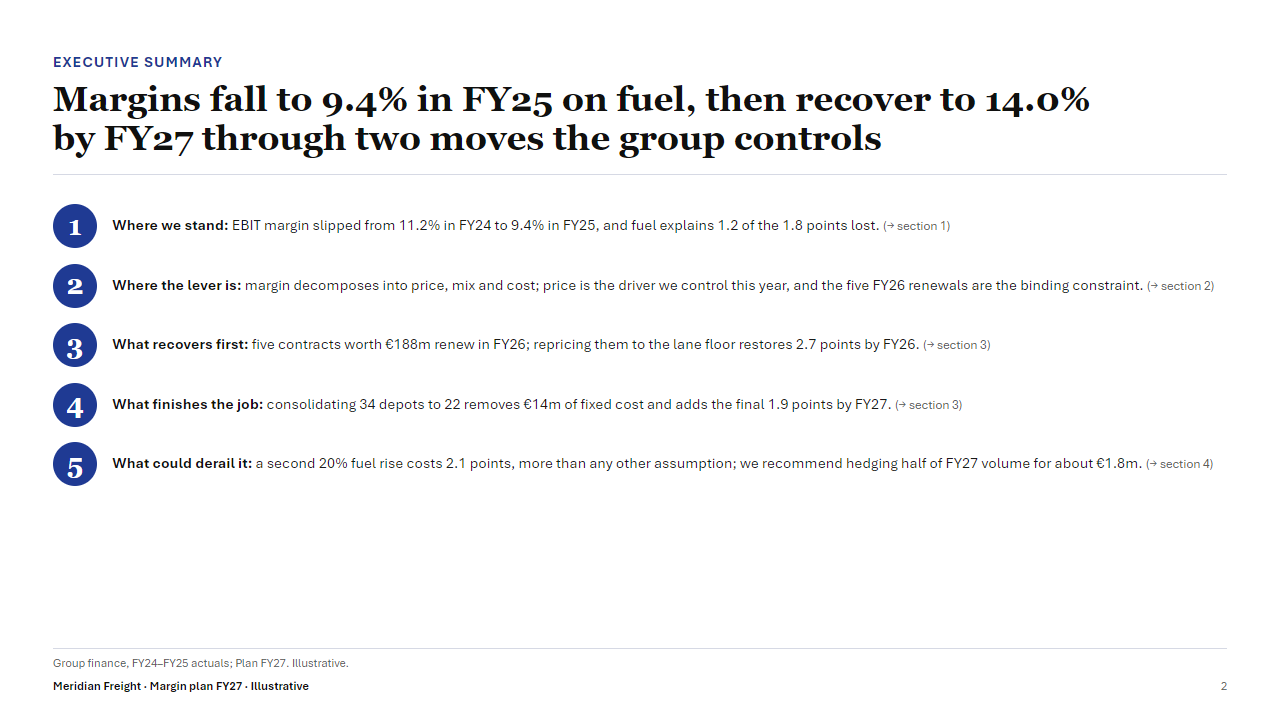
An executive summary slide in the Consulting style: five numbered steps, each with a bold lead-in and a pointer to the section that proves it, under the title Margins fall to 9.4% in FY25 on fuel, then recover to 14.0% by FY27 through two moves the group controls.

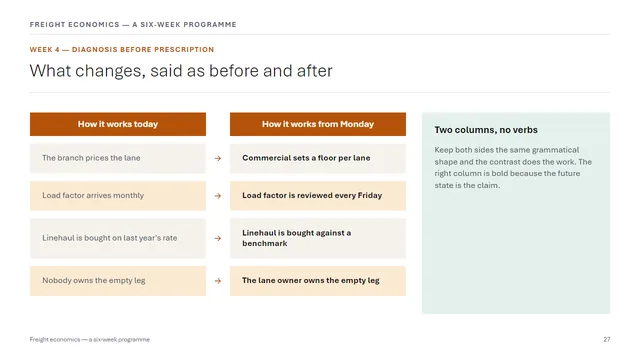
Consulting style, the executive summary of the sample deck. Every number on it is a named value.

Private by design

Your decks stay on your machine

Decks are files on your disk. There is no Decklay cloud, so there is nothing to approve as a new data processor. When you want nothing to leave the machine, nothing does.

  • No cloud, no telemetry by defaultYour deck is a Markdown file wherever you keep it, a shared drive included.
  • AI only when you ask, only to your providerDeck text leaves the machine only for AI requests, and only to your own Claude account. Switches control web search and what is sent.
  • An audit trail you ownAn opt-in AI log is kept as text beside the deck, never sent anywhere.
  • Deterministic outputThe same input produces byte-identical output, every time.

Who it's for

For people who have the message and no time to draw it

Corporate teams

Strategy, finance, HR and PMO teams preparing ExCo pre-reads, board books, recommendations and one-to-ones. Start from a memo or report and let The Committee read it as the CFO first.

Independent consultants

Proposals and steering-committee decks that look like a big firm made them. The frameworks pack arrives pre-filled: SWOT, BCG matrix, five forces, 7S, PESTLE.

Learning and research

Lessons, literature reviews and study references, with numbered LaTeX equations set by the compiler and kept editable in every export.

Large teams and firms

One locked house style across every author. Import the firm's template once and share themes and a decks folder on the drive you already use. Volume licences, and help with IT approval.

Questions

What people ask first

Why write slides in Markdown?

Because typing is faster than drawing. You write one line per idea and the design system sets the slide, so there is nothing to drag, align or resize. You keep full control of every word and number, and the deck stays a text file you can search, compare and hand to any AI.

Do I need to know Markdown?

Not to start. A deck is a heading per slide, a layout line and short blocks for exhibits. The editor autocompletes as you type, a short tour shows the basics, and F1 opens the reference.

Does it run on a Mac?

Not yet. Decklay is a Windows desktop app with a command-line tool.

Do I need an AI subscription?

No. Writing, compiling, presenting and sharing all work without AI. The co-author uses your own Claude subscription (through Claude Code) or an Anthropic API key.

Can I still send a PowerPoint?

Yes, when someone needs the file: text, tables, equations, callouts and charts arrive as editable objects, and charts carry their data. Most decks never need it. Present from the app, or send a PDF or one HTML file.

Can I use my company's template?

Yes. Import the template file once and its colours, fonts and logo come across, each colour checked for legibility. Layouts are not imported: Decklay's own set the slides. If a brand typeface is installed on your machine, Decklay measures it so the layout fits it exactly.

Does it handle Greek?

Yes. Decklay detects a Greek deck and sets uppercase text correctly, without stray accents.

Where do my decks go?

Nowhere you don't put them. Decks are Markdown files on your disk or shared drive. Text leaves your machine only when you ask the AI, and only to your own provider.

Run it through Decklay.

14-day full trial. Everything included, no card needed.